RADICAL ACTION AGAINST FERAL SWINE

Image courtesy of: https://wildlifeinformer.com/dangerous-wildlife-in-florida/
Stopping the Silent Surge in Volusia and Seminole Counties
Why Volusia and Seminole Counties Need Radical Action Against Feral Swine by Kim Eddins 22 June 2026
Across East Central Florida, a silent, destructive, and highly adaptable crisis is moving through our wetlands, timberlands, and suburban borders. Feral swine (Sus scrofa)—originally brought to Florida by Spanish explorers nearly five centuries ago—have evolved from a historical footnote into one of the most pressing ecological and public health threats facing Volusia and Seminole counties today [1.2.3].
With an exponential breeding rate, the absence of natural apex predators, and a destructive path that degrades water quality and threatens human health, these invasive animals have outpaced standard management practices. To protect our local ecosystem, our livestock, and our communities, we must transition from passive monitoring to an aggressive, structured policy of containment and open harvest.
The Biological Engine: Why We Are Losing the Ground War
The fundamental reason feral swine are winning the territory war is their sheer reproductive velocity. Sows can reach breeding maturity in less than a year, producing up to two litters annually with an average of four to eight piglets per litter [1.1.5]. Because adult wild hogs routinely grow to 150–200 pounds and possess thick hides and dangerous tusks, local wildlife like bobcats or coyotes pose no threat to an established sounder (herd).
Left unchecked, a population can easily double or triple in a brief window. Human intervention is the only remaining ecological check on this runaway growth.
Environmental Destruction from the St. Johns to the Basin
Feral swine act as highly destructive "ecosystem engineers." Using their powerful snouts, they root up native topsoil to find roots, fungi, and invertebrates [1.1.2]. This relentless digging disrupts native plant communities, accelerates soil erosion, and causes heavy sediment loading in vital waterways like the St. Johns River basin and local floodplains.
Furthermore, their habit of wallowing in shallow waters introduces massive bacterial loads into the watersheds we rely on. Beyond the terrain, their opportunistic, omnivorous diet makes them an active predator of ground-nesting birds, critical amphibians, and the buried eggs of protected native reptiles [1.1.2].
INVASIVE SWINE ECOLOGICAL FOOTPRINT
1. Rooting Damage: Destroys Topsoil and timber roots and drives erosion.
2. Water Quality: Wallowing loads pathogens into local basins.
3. Native Predation: Devours eggs of ground-nesting birds and reptiles.
A Hidden Public Health and Biological Threat
The threat is not merely environmental; it is a clear vector for disease. Feral swine are known hosts for numerous parasites, viruses, and bacterial pathogens that threaten livestock, pets, and humans alike:
· Swine Brucellosis (Brucella suis): A severe bacterial infection that can be transmitted to humans and hunting dogs through raw meat or fluids during field dressing, leading to chronic, debilitating joint, heart, and fever symptoms [1.1.3].
· Pseudorabies: While harmless to humans, this highly contagious virus is nearly 100% fatal to domestic dogs and cats, causing rapid neurological failure and intense, agonizing itching ("mad itch") within days of contact.
· Leptospirosis: Shed through swine urine directly into standing surface waters, this pathogen poses a direct threat of liver and kidney damage to anyone wading in or drinking from affected rural water sources.
The Solution: A Coordinated, Tracking-Driven Ordinance
To turn the tide, Volusia and Seminole counties must implement a unified, data-driven ordinance that combines maximum incentives for hunters with strict state-level tracking. By maintaining an aggressive open harvest on private lands and raising daily public limits to ten hogs per day, we can mobilize responsible hunters and land managers to act as the missing predatory force.
Crucially, this effort must be guided by technology. By implementing a centralized digital registry that requires GPS mapping of harvests and tracking of trail camera data, county conservation offices can map herd migrations in real time. This ensures we are targeting high-density breeding sounders rather than blindly scattered groups.
We can no longer treat the wild hog problem as a minor rural nuisance. It is an active assault on Florida's natural beauty, agricultural safety, and public health. A structured, aggressive containment ordinance is the only way to safeguard our counties for generations to come.
References & Citations
· [1.1.2] USDA Animal and Plant Health Inspection Service (APHIS). Feral Swine: Impacts on Threatened and Endangered Species. National Feral Swine Damage Management Program.
· [1.1.3] Florida Fish and Wildlife Conservation Commission (FWC). Swine Brucellosis Advisory and Health Transmission Data.
· [1.1.5] University of Florida (UF) Institute of Food and Agricultural Sciences (IFAS) Extension. Hog Wild in Florida! Feral Pigs a Problem. Publication WEC277.
· [1.2.3] Florida Fish and Wildlife Conservation Commission (FWC). Nonnative Invasive Species Profiles: Wild Hog (Sus scrofa).
MODEL ORDINANCE-FERAL SWINE CONTAINMENT & POPULATION CONTrol

Courtesy of National Deer Association: USDA Aims to Eradicate Feral Hogs In These States
Site Content
Draft by Kimberly Eddins
ORDINANCE NO. [REDACTED]
AN ORDINANCE PROVIDING FOR THE CONTAINMENT AND ERADICATION OF FERAL SWINE (SUS SCROFA); DECLARING AN UNRESTRICTED HARVEST FOR POPULATION CONTROL WITHIN VOLUSIA AND SEMINOLE COUNTIES; ESTABLISHING MAXIMUM DAILY HARVEST INCENTIVES, MANDATORY HARVEST TRACKING, AND HERD MOVEMENT REPORTING PROTOCOLS; OUTLINING ENVIRONMENTAL AND PUBLIC HEALTH HAZARDS; AND PROVIDING AN EFFECTIVE DATE.
SECTION I: FINDINGS OF FACT, BIOLOGY, AND ECOLOGICAL IMPACT
A. Introduction and Origin
Feral swine (Sus scrofa), also known as wild hogs or feral pigs, are an invasive exotic species originally introduced to Florida by Spanish explorers, notably Hernando de Soto, in 1539. Over centuries, escaped domestic swine, Eurasian wild boars, and their hybrids have multiplied exponentially. They are now established across all 67 counties in Florida, with dense, highly destructive concentrations thriving in the wetlands and wooded tracts of East Central Florida, including Volusia and Seminole Counties.
B. Reproductive Capacity and Diet
Feral swine are among the most prolific breeders of any large mammal on earth.
· Breeding Habits: Sows reach sexual maturity as early as 20 to 51 weeks of age and can produce up to two litters per year. The typical gestation period is approximately 114 to 116 days, with an average litter size ranging from 4 to 8 piglets (Knox, R. V., 2026, January[1]).
· Dietary Habits: Feral swine are aggressive, highly opportunistic omnivores. While their preferred seasonal diet consists of hard mast (such as acorns and palmetto berries), they will consume virtually anything. This includes native agricultural crops, timber seedlings, invertebrates, and small vertebrates such as amphibians, reptiles, and mammals (Animal and Plant Health Inspection Service [APHIS], 2026)[2].
C. Lack of Natural Predators
Adult feral swine routinely exceed 150 to 200 pounds and possess thick hides and sharp tusks, leaving them with effectively zero natural apex predators in Volusia and Seminole Counties. While juvenile piglets are occasionally preyed upon by opportunistic coyotes or bobcats, natural predation fails completely to check population growth. Human intervention via targeted trapping and hunting remains the only viable mechanism for population reduction (Giuliano, 2021)[3].
D. Environmental and Habitat Destruction
Feral swine act as destructive "ecosystem engineers" that fundamentally degrade the native Florida rangeland, timberlands, and wetlands:
1. Rooting and Wallowing: Hogs use their powerful snouts to excavate large swaths of topsoil in search of subterranean roots and fungi. This destructive "rooting" alters plant community compositions, destabilizes soil structures, and accelerates severe erosion and sediment loading along local river floodplains (such as the St. Johns River basin shared by Volusia and Seminole Counties), (Volusia County Parks, Recreation and Culture, n.d.)[4].
2. Water Quality Degradation: Their habit of wallowing in shallow waters destroys small ponds and stream banks, which introduces massive bacteria and mud loads, heavily disrupting delicate aquatic ecosystems (Elwell et al., 2025)[5].
3. Predation on Endangered Species: They actively prey upon ground-nesting birds, critical amphibians, and the buried eggs of protected reptiles (Shipes et al., 2023)[6].
SECTION II: PUBLIC HEALTH AND EPIDEMIOLOGICAL THREATS
Feral swine serve as primary reservoirs for numerous parasites, viral strains, and bacterial pathogens (Miller et al., 2018)[7]. This ordinance acknowledges the severe biological threat posed to livestock, domestic pets, and human populations, including but not limited to:
Learn More
· Knox, R. V. (2026, January). Breeding Management of Pigs. Merck Veterinary Manual. https://www.merckvetmanual.com/management-and-nutrition/management-of-reproduction-pigs/breeding-management-of-pigs.
· Animal and Plant Health Inspection Service. (2026, January 11). Feral swine damage: Natural resources. U.S. Department of Agriculture. https://www.aphis.usda.gov/operational-wildlife-activities/feral-swine/damage-natural-resources.
· Giuliano, W. M. (2021). Control and management of wild hogs in Florida. UF/IFAS Extension. https://ufdcimages.uflib.ufl.edu/IR/00/00/24/43/00001/UW22100.pdf[1].
· Volusia County Parks, Recreation, and Culture. (n.d.). Deep Creek Preserve management plan. Volusia County Government. https://www.volusia.org/file/7237/FINAL-DRAFT-DCP-MP-for-Public-Hearing.pdf.
· Elwell, J. A., Shipes, J. C., & Bolds, S. A. (2025). Large-scale assessment of the impacts of invasive wild pigs on water quality in freshwater streams. Journal of Environmental Quality, 54(3), 312–324. https://pmc.ncbi.nlm.nih.gov/articles/PMC12125311/.
· Shipes, J. C., Bolds, S. A., Sumners, J. A., Ditchkoff, S. S., & Green, A. M. (2023). DNA metabarcoding reveals that invasive wild pigs consume a diverse community of vertebrates. Scientific Reports, 13, Article 20955. https://www.nature.com/articles/s41598-023-48139-9.
· Miller, R. S., Sjeklocha, D. B., & Bevins, S. N. (2018). Zoonotic pathogens from feral swine that pose a significant threat to public health. Transboundary and Emerging Diseases, 65(2), 341–350.
· Florida Department of Agriculture and Consumer Services. (2026). Swine movement requirements: Feral swine movement. https://www.fdacs.gov/Agriculture-Industry/Livestock/Animal-Movement/Swine-Movement-Requirements.
About Us
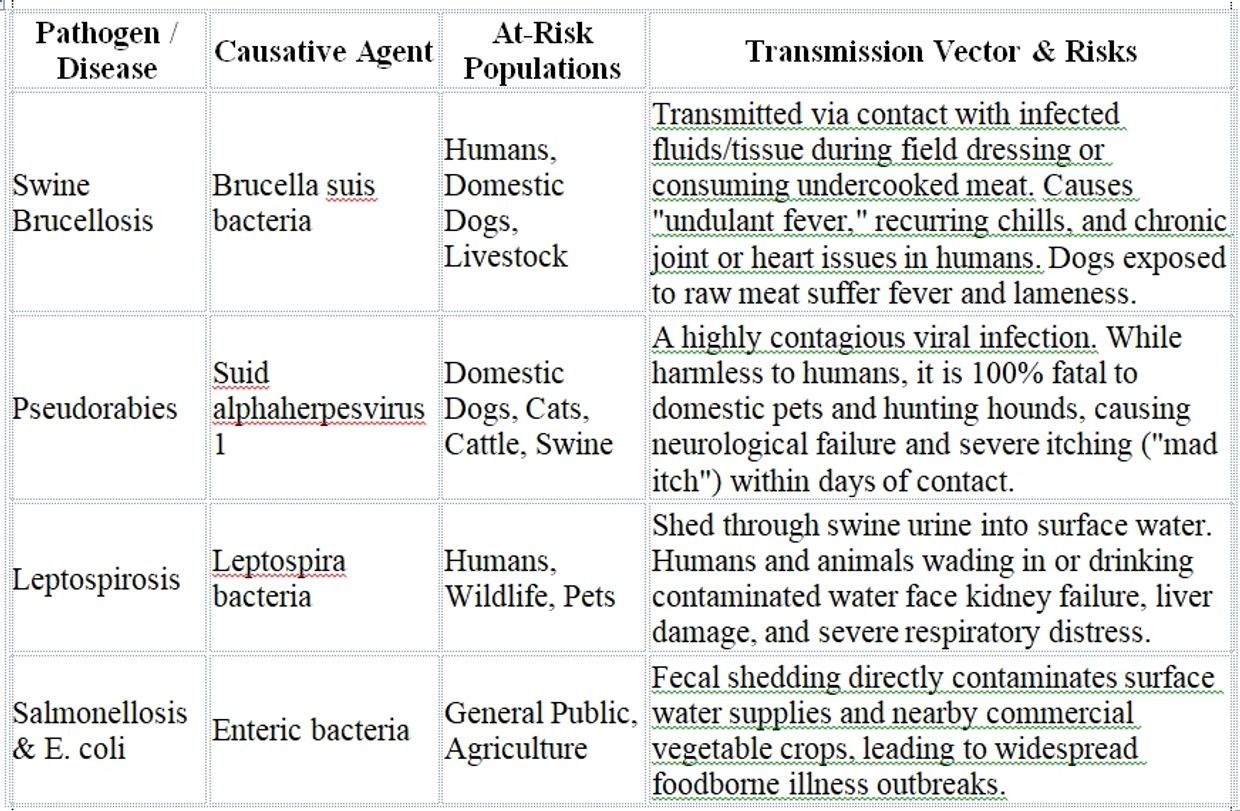
WE ARE FACING A POTENTIAL SERIES OF EPIDEMICS OF GLOBAL PROPORTIONS
MODEL ORDINANCE-FERAL SWINE CONTAINMENT and population control Part II
SECTION III: DECLARATION OF OPEN HARVEST, HARVEST LIMITS, AND TRACKING
A. Declaration of Open Harvest (Containment Window)
To the furthest extent permitted under the Florida Fish and Wildlife Conservation Commission (FWC) guidelines for non-native invasive species, Volusia and Seminole Counties hereby declare an Unrestricted Open Harvest on feral swine on all designated public lands within county jurisdiction and all private lands where express owner permission is granted.
B. Daily Harvest Limits
1. Private Lands: Pursuant to the state framework, there shall be no bag limit and no size limit for the taking of feral swine on private property.
2. County-Managed Public Lands: A generous incentive harvest limit of ten (10) feral swine per hunter, per day is established to encourage aggressive population culling while managing hunter safety and field congestion.
C. Mandatory Tracking and Herd Movement Registry
To accurately chart sounder (herd) dynamics, identify high-density breeding zones, and execute precise containment protocols, a (proposed) centralized Digital Feral Swine Registry is hereby established.
1. Mandatory Harvest Reporting: Any hunter or trapper who dispatches a feral pig within the boundaries of Volusia or Seminole County must log the kill within twenty-four (24) hours via the county portal. The report must include:
o Exact GPS coordinates of the harvest.
o Weight, sex, and approximate age (adult vs. piglet) of the animal.
o Photographic confirmation of the dispatched swine.
2. Herd Movement Reports: Agricultural landowners, land managers, and citizens are urged to upload trail camera metadata or physical rooting sightings to map real-time herd migrations across county borders.
3. Live Transportation Ban: In strict accordance with the Florida Department of Agriculture and Consumer Services (FDACS), it is strictly unlawful to transport any live feral swine within county limits without an explicit state-issued holding and transport permit. All captured animals must be humanely dispatched on-site (Florida Department of Agriculture and Consumer Services [FDACS], 2026)[8].
SECTION IV: SEVERABILITY AND EFFECTIVE DATE
If any section, phrase, or provision of this ordinance is for any reason held invalid or unconstitutional by a court of competent jurisdiction, such portion shall be deemed separate, and the validity of the remaining portions shall remain unaffected. This ordinance shall take effect immediately upon filing with the Department of State.
REFERENCES/CITATIONS
· [1.1.1] Southwest Florida Water Management District (SWFWMD), Feral Hog Hunts Frequently Asked Questions.
· Knox, R. V. (2026, January). Breeding Management of Pigs. Merck Veterinary Manual. https://www.merckvetmanual.com/management-and-nutrition/management-of-reproduction-pigs/breeding-management-of-pigs.
· Animal and Plant Health Inspection Service. (2026, January 11). Feral swine damage: Natural resources. U.S. Department of Agriculture. https://www.aphis.usda.gov/operational-wildlife-activities/feral-swine/damage-natural-resources.
· Giuliano, W. M. (2021). Control and management of wild hogs in Florida. UF/IFAS Extension. https://ufdcimages.uflib.ufl.edu/IR/00/00/24/43/00001/UW22100.pdf [1].
· Volusia County Parks, Recreation, and Culture. (n.d.). Deep Creek Preserve management plan. Volusia County Government. https://www.volusia.org/file/7237/FINAL-DRAFT-DCP-MP-for-Public-Hearing.pdf.
· Elwell, J. A., Shipes, J. C., & Bolds, S. A. (2025). Large-scale assessment of the impacts of invasive wild pigs on water quality in freshwater streams. Journal of Environmental Quality, 54(3), 312–324. https://pmc.ncbi.nlm.nih.gov/articles/PMC12125311/.
· Shipes, J. C., Bolds, S. A., Sumners, J. A., Ditchkoff, S. S., & Green, A. M. (2023). DNA metabarcoding reveals that invasive wild pigs consume a diverse community of vertebrates. Scientific Reports, 13, Article 20955. https://www.nature.com/articles/s41598-023-48139-9.
· [1.1.2] USDA Animal and Plant Health Inspection Service (APHIS), Feral Swine: Impacts on Threatened and Endangered Species.
· Miller, R. S., Sjeklocha, D. B., & Bevins, S. N. (2018). Zoonotic pathogens from feral swine that pose a significant threat to public health. Transboundary and Emerging Diseases, 65(2), 341–350.
· [1.1.3] Florida Fish and Wildlife Conservation Commission (FWC), Swine Brucellosis Advisory and Health Transmission Data.
· [1.1.4] Archbold Biological Station, Feral Swine Ecology & Management Project (2015-2026 data).
· [1.1.5] University of Florida (UF) Institute of Food and Agricultural Sciences (IFAS) Extension, Hog Wild in Florida! Feral Pigs a Problem.
· [1.2.3] Florida Fish and Wildlife Conservation Commission (FWC), Nonnative Invasive Species Profiles: Wild Hog (Sus scrofa).
· Florida Department of Agriculture and Consumer Services. (2026). Swine movement requirements: Feral swine movement. https://www.fdacs.gov/Agriculture-Industry/Livestock/Animal-Movement/Swine-Movement-Requirements.
[1] Knox, R. V. (2026, January). Breeding Management of Pigs. Merck Veterinary Manual. https://www.merckvetmanual.com/management-and-nutrition/management-of-reproduction-pigs/breeding-management-of-pigs
[2] Animal and Plant Health Inspection Service. (2026, January 11). Feral swine damage: Natural resources. U.S. Department of Agriculture. https://www.aphis.usda.gov/operational-wildlife-activities/feral-swine/damage-natural-resources.
[3] Giuliano, W. M. (2021). Control and management of wild hogs in Florida. UF/IFAS Extension. https://ufdcimages.uflib.ufl.edu/IR/00/00/24/43/00001/UW22100.pdf[1].
[4] Volusia County Parks, Recreation, and Culture. (n.d.). Deep Creek Preserve management plan. Volusia County Government. https://www.volusia.org/file/7237/FINAL-DRAFT-DCP-MP-for-Public-Hearing.pdf.
[5], Elwell, J. A., Shipes, J. C., & Bolds, S. A. (2025). Large-scale assessment of the impacts of invasive wild pigs on water quality in freshwater streams. Journal of Environmental Quality, 54(3), 312–324. https://pmc.ncbi.nlm.nih.gov/articles/PMC12125311/.
[6] Shipes, J. C., Bolds, S. A., Sumners, J. A., Ditchkoff, S. S., & Green, A. M. (2023). DNA metabarcoding reveals that invasive wild pigs consume a diverse community of vertebrates. Scientific Reports, 13, Article 20955. https://www.nature.com/articles/s41598-023-48139-9.
[7] Miller, R. S., Sjeklocha, D. B., & Bevins, S. N. (2018). Zoonotic pathogens from feral swine that pose a significant threat to public health. Transboundary and Emerging Diseases, 65(2), 341–350. doi.org.
[8] Florida Department of Agriculture and Consumer Services. (2026). Swine movement requirements: Feral swine movement. https://www.fdacs.gov/Agriculture-Industry/Livestock/Animal-Movement/Swine-Movement-Requirements
This website uses cookies.
We use cookies to analyze website traffic and optimize your website experience. By accepting our use of cookies, your data will be aggregated with all other user data.